CogniPD+: Advancing a First-in-Class Therapy for Parkinson’s Disease Dementia
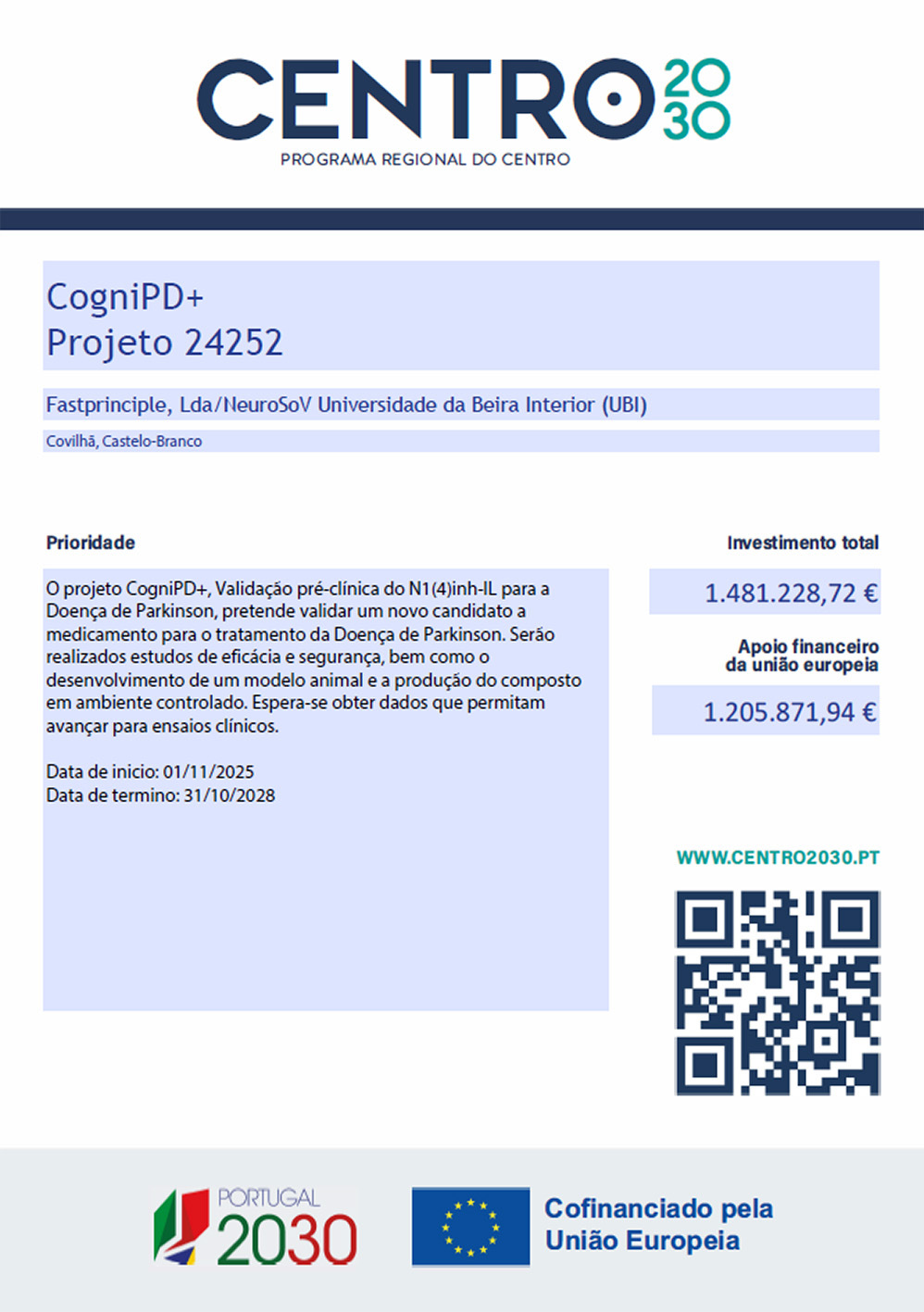
CogniPD+ is a pre-clinical project developing N1(4)inh-IL, a selective Nox1/4 inhibitor for intranasal brain delivery targeting cognitive decline in Parkinson’s Disease.
Unmet Clinical Need
Parkinson’s Disease Dementia (PDD) is a severe and progressive neurodegenerative condition affecting approximately 30% of Parkinson’s patients, which significantly impairs memory, executive function, and patient autonomy. Despite its enormous burden on patients and caregivers, there are currently no approved therapies capable of modifying disease progression.
Oxidative Stress & Nox1/Nox4
Neurodegeneration in PDD is driven by oxidative stress linked to the NADPH oxidases Nox1 and Nox4, which are overexpressed in patients’ brains. Nox4, in particular, accumulates in the hippocampus and correlates with the build-up of α-synuclein, β-amyloid, and tau, which are key proteins associated with cognitive decline.
Failed Existing Approaches
The existing NOx inhibitors have failed to demonstrate efficacy in clinical practice due to their poor selectivity, low bioavailability, and significant toxicity. No compound targeting this pathway is currently in an advanced stage of clinical development for neurodegenerative diseases. This is the gap CogniPD+ addresses.
N1(4)inh-IL: A First-in-Class Nox1/Nox4 Inhibitor in Ionic Liquid Form
Ionic Liquid Formulation · Intranasal Brain Delivery
N1(4)inh-IL was developed at the University of Beira Interior (UBI – RISE Health) and is exclusively licensed to NeuroSoV (Fastprinciple, Lda). It selectively inhibits the Nox1 and Nox4 oxidase isoforms by blocking the oxidative cascade that drives dopaminergic neurodegeneration, neuroinflammation, mitochondrial dysfunction, and pathological protein aggregation.
The compound is formulated as an ionic liquid optimized for intranasal delivery, enabling efficient brain targeting and enhanced bioavailability.
This combination of molecular precision, innovative formulation, and targeted delivery route creates a profile with no direct equivalent in the current drug development landscape.
Differentiators in N1(4)inh-IL
🧬
First-in-Class Nox1/4 Inhibition
🧠
Intranasal Delivery to the Brain
💧
Ionic Liquid Formulation
🐀
Translational Preclinical Model
📋
Regulatory Alignment
🔒
Intellectual Property
This integrated approach positions N1(4)inh-IL as a disruptive solution in the treatment of neurodegenerative diseases.
From Proof of Concept to Regulatory Readiness
PDSolve (PT2020)
Proof of Concept
CogniPD+
TRL 4–5 → TRL 6–7
IND/CTA
Submission
Phase I
Entry 2029–2030
CogniPD+ is currently at the preclinical stage (TRL 4–5) and aims to reach regulatory-ready (TRL 6–7) by the end of the project. The project builds on robust proof-of-concept data from the predecessor project PDSolve (PT2020), including in vivo prevention of motor dysfunction in rodent models of PD, preliminary pharmacokinetics, safety, and blood–brain barrier validation.
The next milestone is regulatory preparation for IND/CTA submission and entry into clinical trials, closing the critical gap towards translation.
Five Interconnected Activities Over 36 Months
CogniPD+ is a 36-month R&D programme structured around five interconnected activities spanning regulatory-aligned preclinical development, in vivo and translational efficacy studies, scientific dissemination and valorization, and integrated project management — together building a comprehensive path from proof of concept to clinical readiness.
Complementary Competencies Across All Dimensions of Drug Development
CogniPD+ is led by NeuroSoV (Fastprinciple, Lda), in co-promotion with the University of Beira Interior (UBI – RISE-Health). The project team integrates complementary competencies across all dimensions of drug development — from basic science to clinical strategy and market access.
NeuroSoV (Fastprinciple, Lda)
Ana Clara Cristóvão
CSO & PI
Neurodegenerative disease researcher with deep expertise in Parkinson’s disease, NADPH oxidase biology and preclinical model development. Leads the company’s scientific vision, ensuring coordination between academic and industry partners. Coordinates teams, supervises doctoral students, and maintains active international collaborations.
Dina Pereira
CEO
Innovation project management specialist and executive director of UBImedical. Leads business development, international partnerships and operational management.
Ricardo Pacheco
CMO
Physician with an MBA who has held positions at multinational companies such as Novartis, Roche, and AstraZeneca. Leads the company’s clinical and regulatory strategy and ensures alignment with market requirements and industry stakeholders.
João Leitão
CFO
Professor of Economy and specialist in finance, sustainability, and entrepreneurship. Ensures the project’s economic and financial viability, as well as its value-creation strategy.
UBI (RISE-Health)
Gilberto Alves
Pharmaceutical Sciences
Professor of Pharmaceutical Sciences, specialist in pharmacokinetics and metabolism (ADME), with extensive experience in regulatory preclinical studies.
Samuel Silvestre
Pharmaceutical Sciences
Professor of Pharmaceutical Sciences, responsible for providing support in medicinal chemistry and for the analysis and validation of the stability and reactivity of the N1(4)inh-IL formulation.
Luís Passarinha
Biomedicine
Professor of Biomedicine, specialist in biochemistry and chromatographic techniques, with experience in quantifying neurotransmitters in animal models, will be responsible for assisting with the quantification of dopamine and its metabolites using HPLC.
External Consultants & Partners
Mara Freire
CICECO, University of Aveiro
International expert in ionic liquid chemistry. Advises on formulation design and optimisation.
Marcelo Mendonça
Champalimaud Foundation
Clinical neurologist. Ensures clinical relevance of endpoints and supports regulatory and clinical translation strategy.
Yoon-Seong Kim
Rutgers University, USA
Professor of Neurology and specialist in Parkinson’s molecular mechanisms. Supports translational model validation.
Doctoral Researchers
Mariana Fiadeiro
Senior PhD Researcher
Senior PhD researcher with experience in Parkinson’s models. Active across Activities 2 and 3.
Ana Alexandra Silva
PhD Researcher
PhD researcher contributing to in vivo testing and biochemical analysis.
Rita Curto
PhD Researcher
PhD researcher leading experimental execution in Activity 2, under supervision of Dr. Ana Clara Cristóvão.
Building the Path to Clinical Translation
By the end of CogniPD+ (September 2028), NeuroSoV (Fastprinciple, Lda) aims to hold a complete preclinical regulatory dossier, positioning N1(4)inh-IL for IND/CTA submission and Phase I entry, estimated for 2029–2030.
With this solid preclinical foundation, we are actively engaging pharmaceutical and biotech companies, as well as institutional investors, to explore co-development, licensing, and out-licensing opportunities. Initial discussions with pharmas have already begun, strengthening the path towards strategic partnerships and clinical translation.
Licensing Opportunity — N1(4)inh-IL
- First-in-class mechanism (selective Nox1/Nox4 inhibition)
- Innovative pharmaceutical ionic liquid formulation
- Intranasal CNS delivery (proven blood–brain barrier penetration)
- Patent protected internationally (PCT WO2023144742A1)
- TRL 6–7 by end of 2028
- Phase I entry estimated 2029–2030
Secondary Opportunity — PDD Animal Model
- Novel paraquat-induced PDD animal model
- Offered as a specialised preclinical service from 2028/29
- Designed for evaluating cognitive therapies
- Target users: pharmaceutical companies and CROs
We Welcome Engagement With
We welcome engagement with pharmaceutical companies in neuroscience, biotech companies in CNS and neurodegeneration, venture capital and corporate VC, innovation funding bodies (e.g. EIC Accelerator), and strategic co-development partners.
For scientific collaboration enquiries, partnership and licensing discussions, or media and press requests, please contact the CogniPD+ project team.
Co-funding